
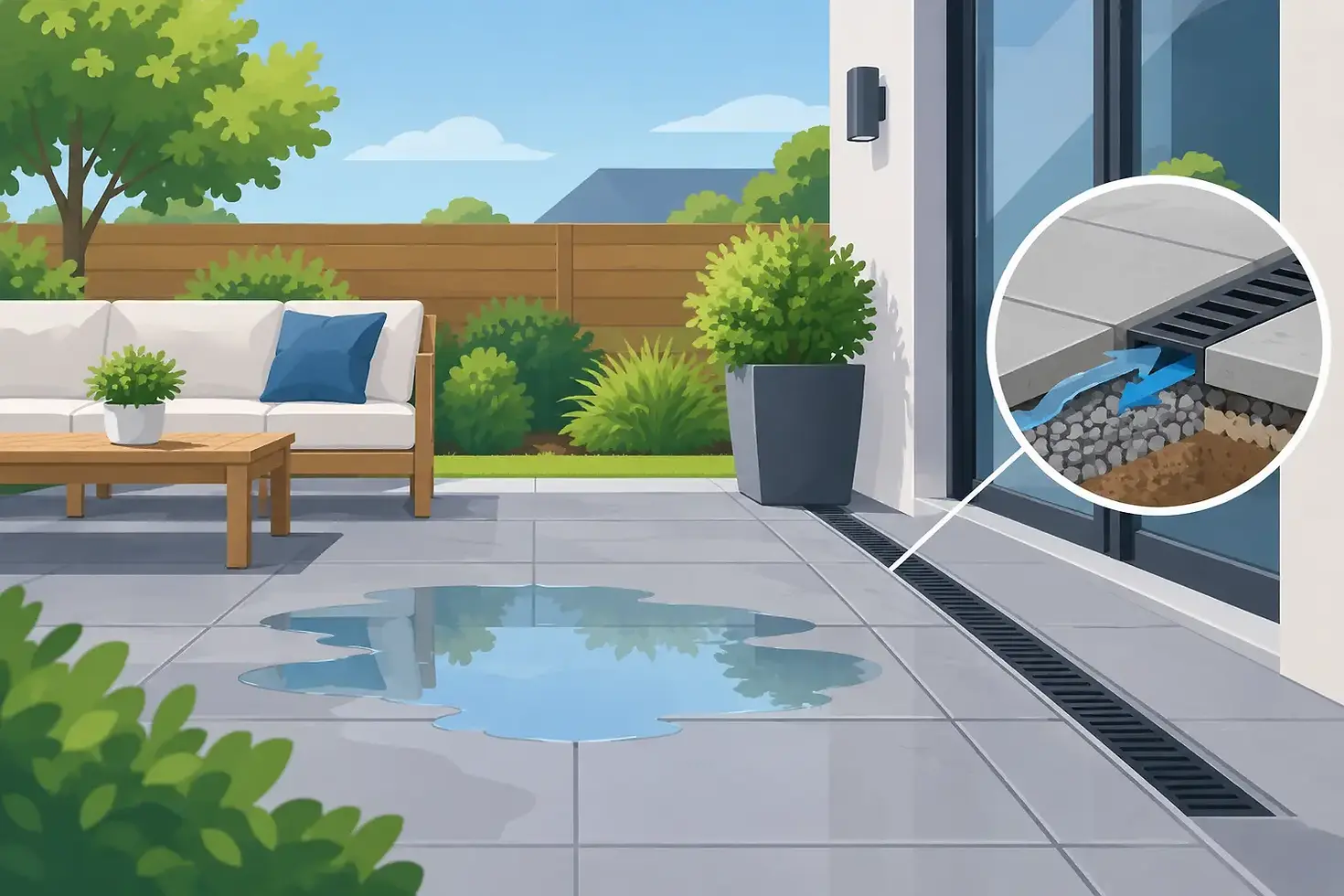
How to Prevent Patio Puddling Before It Spreads
A patio should shed water, not hold it. If water remains on the surface hours after rain or washing, the concrete is telling you something about its slope, drainage path, or support underneath. Knowing how to prevent patio puddling starts with finding out whether the water is sitting in one low spot or whether the entire patio was built without a reliable way to drain.
A little dampness immediately after a storm is normal. A standing puddle that collects dirt, leaves a dark stain, attracts mosquitoes, or stays wet into the next day is not. Over time, that trapped water can accelerate surface wear, feed mildew along the house, soften adjacent soil, and make a patio more slippery than it should be.
Why Patio Puddles Form
Most patio puddling comes down to elevation. Concrete needs intentional fall so water moves away from the structure and toward an approved drainage area. For a typical residential patio, a common target is a minimum slope of about 1/8 inch per foot, with 1/4 inch per foot often preferred where conditions allow. The exact layout depends on the patio size, door thresholds, surrounding grades, and where water can legally and practically go.
The problem may have been present from installation, especially on a patio that was finished flat for appearance instead of placed to drain. It can also develop later. Soil movement, poor compaction, water leaking at a gutter or irrigation line, and an inadequate base can allow a section of slab to settle. When that happens, the low area becomes the collection point.
Drainage outside the patio matters just as much. A properly sloped slab still cannot perform well if downspouts dump roof runoff directly onto it or if landscaping creates a soil dam at the patio edge. In Orange County, a patio may go months with little rain, which makes drainage problems easy to overlook. Then a hard winter storm reveals every low spot. In Mohave County, monsoon rain can put a large amount of water on a hardscape in a short period. Both conditions call for a drainage plan, not just a concrete patch.
How to Prevent Patio Puddling With Proper Layout
The best time to prevent puddling is before concrete is poured. Start by identifying the high point, the intended discharge point, and every fixed elevation that limits the design. Sliding doors, thresholds, existing walkways, pool coping, retaining walls, and property lines all affect where a patio can slope.
The finished patio should direct water away from the home without sending it toward a neighbor, a foundation wall, or an area where it will undermine soil. On a large patio, one uniform slope may not be practical or attractive. A contractor may use multiple drainage planes, a swale beyond the slab, a trench drain, or carefully placed area drains. The right option depends on the site.
Before any pour, check the forms with a level, laser, or string line. Do not rely on a visual guess. A patio can look flat and still have enough fall to drain, but it needs to be measured. Forms establish the finished elevation, so correcting slope after concrete placement is far more difficult and usually more expensive.
Protect Door and Threshold Elevations
Door clearances create one of the most common patio drainage challenges. Homeowners often want a patio raised close to the threshold for an easy transition. That can work, but only if there is still room to create slope away from the house and maintain proper flashing and drainage details.
If the available elevation is tight, lowering the patio edge, adding a drain at the doorway, or redesigning the hardscape may be necessary. Raising concrete until it is nearly level with a door without accounting for water movement can direct runoff back toward the building. That is not a trade-off worth making for a slightly flatter step outside.
Build a Base That Supports the Slab
Concrete follows the support below it. If the subgrade is soft, loose, wet, or poorly prepared, the patio can settle even when the original slope was correct. Proper remove-and-replace work includes excavation to the required depth, removal of unsuitable material where needed, grading, and compaction before base material and concrete go in.
The base depth and material depend on soil conditions, slab thickness, intended use, and local requirements. A small backyard sitting patio has different needs than a patio carrying heavy outdoor kitchen components, masonry features, or vehicle access. Still, the principle is the same: stable, compacted support reduces the chance that a section drops and turns into a birdbath.
Pay attention to water sources below and beside the slab. A broken irrigation line, leaking hose bib, or downspout outlet can wash fines out of the soil and weaken support. Correct the source before repairing the concrete. Otherwise, the new repair may fail for the same reason as the old patio.
Keep Water From Reaching the Low Spots
A patio does not work alone. Gutters, downspouts, landscape grades, and nearby hardscape all contribute to its performance. Roof water should be carried beyond the patio through downspout extensions, buried drain lines, or another site-appropriate system. Avoid allowing a concentrated downspout discharge to hit one slab corner repeatedly.
Landscape beds should not be built up higher than the concrete edge. Mulch, decorative rock, and soil can trap water against the patio or reverse the drainage path. Maintain a clear route for runoff to leave the slab. If a planter or wall blocks that route, an area drain or channel drain may be needed.
Control joints also deserve attention. They are not drains, but correctly planned joints help manage cracking as concrete shrinks and moves. Random cracking can create uneven edges and small depressions that hold water. Saw cuts or tooled joints placed at appropriate spacing give the slab a planned location to crack while keeping the surface more orderly.
When a Surface Repair Can Work
Not every puddle requires demolition. If the slab is structurally sound and the low spot is shallow, a bonded cementitious overlay or a targeted repair may restore drainage. The existing concrete must be properly cleaned, mechanically prepared, and evaluated for cracking, movement, and moisture issues. Simply spreading bag mix over a dirty patio usually leads to debonding and another repair down the road.
Grinding can also help in limited cases, such as a small high ridge that prevents water from moving toward the drain path. It is not the answer for a broad low area, and aggressive grinding can expose aggregate or create an uneven-looking finish. Decorative stamped concrete and exposed aggregate require even more caution because repairs can be visible.
Slab lifting may be an option when a large section has settled but remains in good condition. Whether lifting makes sense depends on the cause of settlement, slab condition, access, and the amount of elevation correction needed. It can improve drainage, but it does not replace fixing poor exterior drainage or unstable soils.
When Remove-and-Replace Is the Better Fix
Replacement is usually the smarter long-term choice when puddling is tied to widespread bad slope, multiple settled areas, significant cracking, heaving, or a failed base. It is also worth considering when the patio needs to be reconfigured for a new cover, outdoor kitchen, walkway, or decorative concrete upgrade.
A full remove-and-replace project lets the crew correct the grade from the ground up. The failed concrete comes out, the subgrade and base can be addressed, drainage can be planned, and new forms can establish the right fall before the pour. It is more involved than a patch, but it solves the actual cause instead of hiding it.
Before committing to any repair, test the patio. Hose down the surface and watch where the water travels, where it stops, and how long it remains. Check gutters and irrigation at the same time. A clear diagnosis is what separates a lasting concrete solution from a temporary cosmetic fix.
If you are planning a new patio or dealing with one that holds water now, treat drainage as part of the concrete work from the first measurement. A well-sloped, well-supported patio gives you an outdoor space you can use after the rain instead of one you have to wait out.


Comments